

Why I Created Before You Click
I didn't set out to write a workbook about scams. In fact, the story behind Before You Click started much closer to home.
Over the years, we experienced a significant financial setback that changed the course of our lives.
We were introduced to an investment opportunity that, on the surface, looked well-structured and legitimate. Formal agreements were signed. Our bank reviewed it and agreed the investment was sound. Everything about it suggested due diligence had already been done, by us and by people who should have known better.
Then, within months, the company collapsed. Investors like us were left holding an agreement that was no longer worth anything.
We'd used our home as collateral. When the Global Financial Crisis hit around the same time, property values fell, and we had no way to recover. We lost our home. Not long after, we lost our business too, because there was no longer enough left to keep it running.
What followed took years to untangle, including fighting a debt that should never have existed in the first place.
Looking back, there were signals I wish I'd paid closer attention to at the time. Not because I wasn't careful, I was, and so was our bank, but because the whole thing was built to look safe. That's what made it so effective.
That period forced me to start thinking differently about what came next.
I needed to look at new possibilities for earning an income, and increasingly, that meant looking online.
As I began exploring online opportunities, I carried that earlier lesson with me. I'd learned the hard way that being careful isn't the same as being safe, and that scams and bad-faith schemes don't usually look risky. They're built to look like exactly the opposite.
The more I searched, learned and interacted online, the more I recognised the same pattern showing up again and again. Situations where it wasn't always obvious who or what could be trusted, dressed up to look exactly as convincing as that first investment had.
It wasn't simply about being "careful enough."
It made me realise that being online safely isn't about knowing everything. It's about having the confidence to stop, question what you're seeing and know what to do when something doesn't feel right.
That became increasingly important to me as I continued learning new skills and exploring what was possible online.
The Launch You process was part of that journey. Not because it suddenly made me an expert, or because I was able to point to some extraordinary financial result, but because it helped me build confidence, learn practical skills and become more comfortable taking things one step at a time.
And somewhere along the way, I realised there was something I wanted to share with other people who might be feeling the same uncertainty.
I didn't want to create another resource that assumed everyone was already confident online.
I wanted something practical.
Something reassuring.
Something that would help you stop for a moment when a message doesn't feel quite right and know what to do next.
That's where the PAUSE method came from.
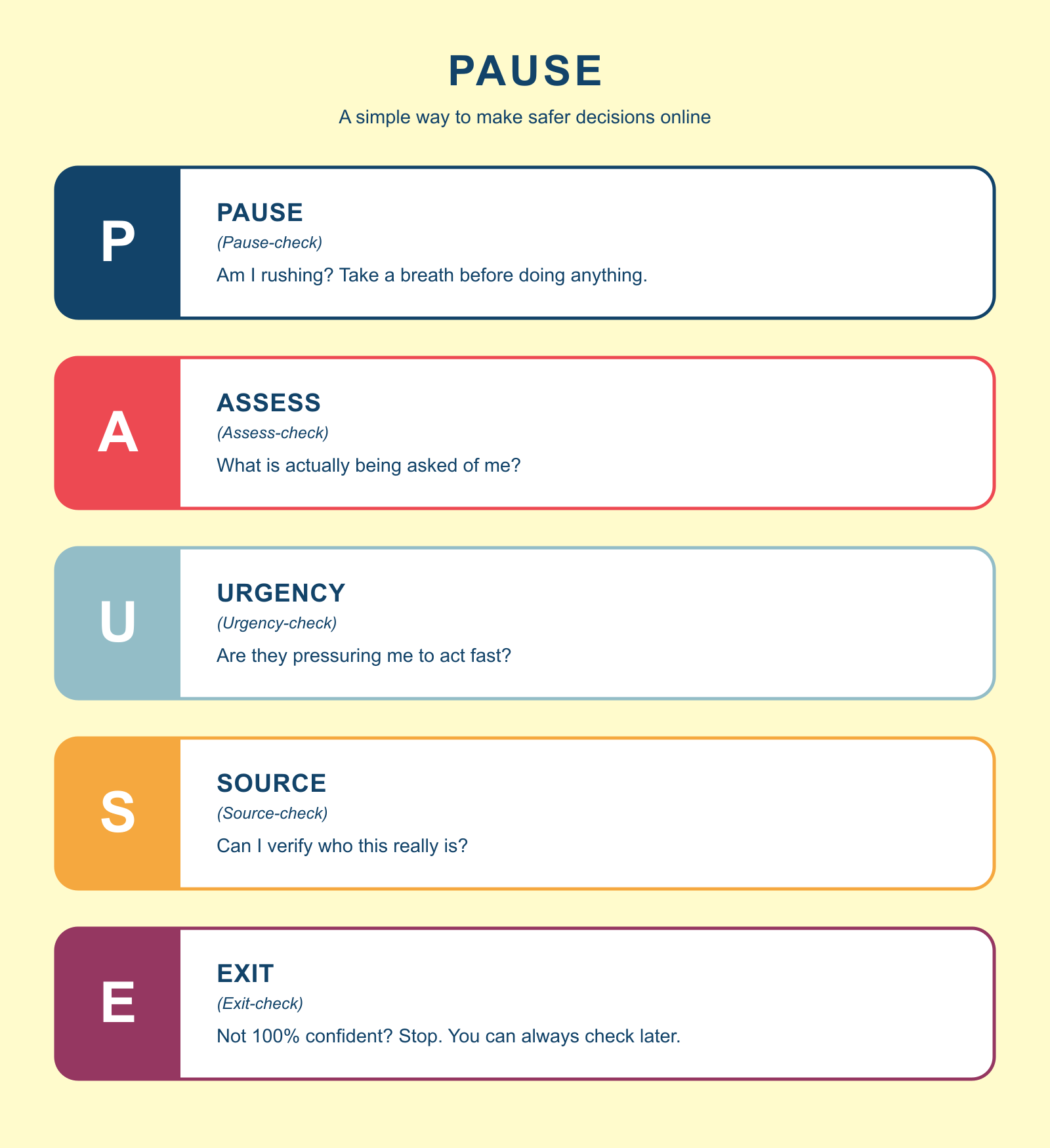
The idea is simple: you don't need to know everything about technology to make safer decisions. Sometimes, you just need a reliable process to fall back on when something doesn't feel right.
That's why I created Before You Click.
It's built around the lessons I've learned, the things I wish I'd known earlier, and the belief that confidence doesn't come from knowing everything.
It comes from knowing what to do next.
If you'd like to build those habits for yourself, Before You Click brings the PAUSE method together in one simple, practical workbook.